
When I am buying a kurti, I have learned that fabric matters just as much as design, maybe even more. It affects how comfortable the kurti feels through the day, how it looks on you, how long it lasts, and how much effort it takes to maintain. I have bought the exact same kurti design in two different fabrics before, and they ended up feeling like two completely different garments.
In this guide, I am going to walk you through the most popular kurti fabrics, their pros and cons, and how to pick the right one depending on the occasion, the season, and how much upkeep you are willing to put in. If you have not already, I would recommend starting with my Kurti Guide for a broader introduction to kurtis before getting into fabric specifics here.
Table of Contents
Why Fabric Matters When Choosing a Kurti
I did not always pay attention to fabric labels, but once I started, I realised how much it changes the experience of actually wearing a kurti. Here is what fabric affects.
- Comfort: Some fabrics feel soft against the skin, while others can feel stiff or scratchy.
- Breathability: This decides how well the fabric lets air pass through, which matters a lot in hot weather.
- Drape: The way a fabric falls and moves with your body changes the entire silhouette of the kurti.
- Durability: Some fabrics hold up to years of wear and wash, while others wear out faster.
- Colour retention: Certain fabrics hold onto dye and prints better than others over repeated washes.
- Wrinkle resistance: This determines how fresh a kurti looks after sitting or travelling in it.
- Ease of maintenance: Some fabrics need dry cleaning or hand washing, while others are low maintenance.
- Suitability for different seasons: A fabric that feels great in winter can feel unbearable in summer, and vice versa.
- Overall appearance: Fabric affects sheen, texture, and how prints or embroidery show up on the kurti.
Once I understood these factors, choosing a kurti fabric stopped feeling random and started feeling like an actual decision. Let me take you through the most popular ones.
Popular Types of Kurti Fabrics
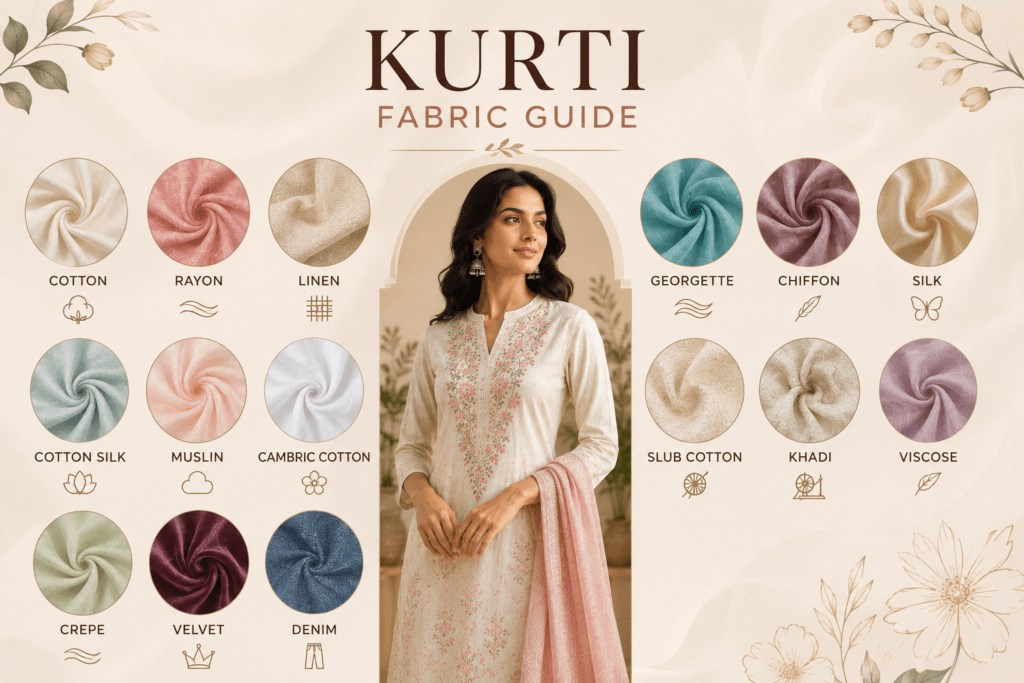
I am covering 15 fabrics here, the ones I see most often when shopping for kurtis or browsing kurti fabric by the metre for tailoring. For each one, I will cover what it is, how it feels, its advantages and disadvantages, the best occasions for it, the ideal weather, and a few styling tips.
1. Cotton
What it is: A natural fibre fabric made from the cotton plant, one of the most commonly used fabrics for kurtis.
Feel and texture: Soft, breathable, and slightly matte in finish.
Advantages: Highly breathable, gentle on the skin, and easy to maintain.
Disadvantages: Wrinkles easily and can shrink slightly if washed in hot water.
Best occasions: Everyday wear, office wear, and casual outings.
Ideal weather: Summer and warm, humid climates.
Styling tips: Cotton kurtis pair beautifully with simple jhumkas or wooden jewellery for a relaxed, everyday look.
2. Rayon
What it is: A semi-synthetic fabric made from regenerated cellulose fibres, often used as a more affordable alternative to silk.
Feel and texture: Smooth, lightweight, and slightly glossy.
Advantages: Drapes well, holds prints and colours nicely, and is comfortable for most of the year.
Disadvantages: Can lose shape over time and is not as breathable as cotton.
Best occasions: Office wear, casual wear, and travel.
Ideal weather: Works well across most seasons except peak summer heat.
Styling tips: Rayon kurtis are great for travel since they resist wrinkles reasonably well and pack easily.
3. Linen
What it is: A natural fabric made from the fibres of the flax plant, known for its light, airy feel.
Feel and texture: Crisp, textured, and slightly stiff when new, softening with wash.
Advantages: Extremely breathable and ideal for hot weather.
Disadvantages: Wrinkles very easily and can feel a bit rough compared to cotton.
Best occasions: Casual wear and daytime summer events.
Ideal weather: Summer and hot, dry climates.
Styling tips: I usually let linen kurtis stay a little relaxed rather than trying to keep them crease free, since the natural texture is part of the appeal.
4. Georgette
What it is: A lightweight, sheer fabric with a slightly crinkled surface, often made from polyester or silk blends.
Feel and texture: Soft, flowy, and slightly grainy to the touch.
Advantages: Drapes beautifully and works well for layered or flowy silhouettes.
Disadvantages: Often sheer, so it usually needs an inner lining.
Best occasions: Festive wear and evening events.
Ideal weather: Works well in moderate weather, less ideal for peak summer since it can feel warm with a lining.
Styling tips: A georgette kurti design with embroidery along the neckline looks elegant with minimal jewellery, letting the fabric movement stand out.
5. Chiffon
What it is: A lightweight, sheer fabric with a slightly rough, textured feel, often used for festive and evening kurtis.
Feel and texture: Soft, sheer, and airy with a subtle sheen.
Advantages: Extremely lightweight and drapes gracefully.
Disadvantages: Delicate fabric that snags easily and requires careful handling.
Best occasions: Festive wear and evening events.
Ideal weather: Best suited for moderate to warm weather, not ideal for daily wear.
Styling tips: I would save chiffon kurtis for occasions where you are not moving around too much, since the fabric needs a bit of care.
6. Silk
What it is: A natural fibre fabric produced from silkworm cocoons, known for its rich texture and sheen.
Feel and texture: Smooth, lustrous, and slightly heavy in hand.
Advantages: Luxurious appearance, holds colour beautifully, and drapes elegantly.
Disadvantages: Requires careful washing, can feel warm to wear, and is usually more expensive.
Best occasions: Weddings and festive wear.
Ideal weather: Better suited for cooler weather or air conditioned settings.
Styling tips: A silk kurti works well with traditional gold or kundan jewellery for a complete festive look.
7. Cotton Silk
What it is: A blended fabric combining cotton and silk fibres, offering a balance between comfort and sheen.
Feel and texture: Soft with a subtle shine, lighter than pure silk.
Advantages: More breathable than pure silk while still offering a festive look.
Disadvantages: Not as breathable as pure cotton and can be slightly delicate.
Best occasions: Festive wear and semi-formal events.
Ideal weather: Works well in moderate and cooler weather.
Styling tips: Cotton silk kurtis are a good middle ground if you want a festive feel without committing to pure silk.
8. Muslin
What it is: A finely woven, lightweight cotton fabric known for its soft, sheer quality.
Feel and texture: Extremely soft, light, and breathable.
Advantages: One of the most breathable fabrics available, gentle on the skin.
Disadvantages: Delicate and prone to tearing with rough handling, often needs a lining.
Best occasions: Casual wear and summer events.
Ideal weather: Ideal for peak summer heat.
Styling tips: Muslin kurtis look best kept simple, since the fabric itself has a naturally elegant, understated quality.
9. Cambric Cotton
What it is: A finely woven, plain weave cotton fabric with a smooth, slightly stiff finish.
Feel and texture: Smooth, crisp, and lightweight.
Advantages: Holds prints well and is easy to maintain.
Disadvantages: Slightly stiffer than regular cotton, which some people find less comfortable.
Best occasions: Everyday wear and office wear.
Ideal weather: Suitable for summer and warm weather.
Styling tips: Cambric cotton kurtis work well for daily wear when you want something neat and low maintenance.
10. Slub Cotton
What it is: A textured cotton fabric with uneven, slightly raised yarns woven into it, giving it a distinct handloom-like texture.
Feel and texture: Slightly textured, breathable, and soft.
Advantages: Breathable, stylish texture, and generally low maintenance.
Disadvantages: Texture may not appeal to everyone looking for a smoother finish.
Best occasions: Casual wear and everyday outings.
Ideal weather: Works well in summer and moderate weather.
Styling tips: I like letting slub cotton kurtis stay minimal in styling, since the fabric texture already adds visual interest.
11. Khadi
What it is: A handspun, handwoven cotton fabric with deep roots in Indian textile tradition.
Feel and texture: Slightly coarse initially, softening with wash and wear.
Advantages: Breathable, durable, and supports traditional handloom weaving.
Disadvantages: Can feel a little rough when new and may wrinkle easily.
Best occasions: Casual wear and everyday festive looks.
Ideal weather: Suitable for most of the year, especially summer.
Styling tips: Khadi kurtis pair beautifully with oxidised jewellery for an earthy, grounded look.
12. Viscose
What it is: A semi-synthetic fabric made from wood pulp, often used as a soft, breathable alternative to cotton or silk.
Feel and texture: Soft, smooth, and slightly cool to the touch.
Advantages: Comfortable, drapes well, and holds colour nicely.
Disadvantages: Can wrinkle and may lose shape after repeated washing.
Best occasions: Casual and office wear.
Ideal weather: Works well in moderate weather.
Styling tips: Viscose kurtis are a good everyday option when you want something soft without the higher maintenance of silk.
13. Crepe
What it is: A fabric with a distinctive crinkled surface, available in both natural and synthetic fibres.
Feel and texture: Slightly textured, lightweight, and fluid.
Advantages: Wrinkle resistant and drapes beautifully, making it great for travel.
Disadvantages: Can feel slightly synthetic depending on the blend.
Best occasions: Office wear, travel, and casual festive looks.
Ideal weather: Works well across most seasons.
Styling tips: I often pack crepe kurtis when travelling since they barely crease, even after being folded in a bag.
14. Velvet
What it is: A dense, plush fabric with a soft, raised pile, often used for winter and festive kurtis.
Feel and texture: Soft, thick, and slightly heavy.
Advantages: Luxurious appearance and provides warmth.
Disadvantages: Not breathable, so it can feel too warm in mild or hot weather.
Best occasions: Winter festive wear and weddings.
Ideal weather: Best suited for winter and cold climates.
Styling tips: Velvet kurtis look striking with statement earrings and minimal other jewellery, since the fabric itself is already rich in texture.
15. Denim
What it is: A sturdy, twill weave cotton fabric traditionally used for jeans, now also seen in casual kurtis.
Feel and texture: Thick, sturdy, and slightly stiff.
Advantages: Extremely durable and low maintenance.
Disadvantages: Heavier and less breathable than other cotton fabrics, not ideal for hot weather.
Best occasions: Casual wear and college wear.
Ideal weather: Better suited for winter and cooler weather.
Styling tips: Denim kurtis work well with simple jewellery and sneakers for a relaxed, everyday look.
Which Fabric Is Best for Different Occasions?
Here is a table I rely on when helping people match kurti fabric to occasion.
| Occasion | Recommended Fabric |
|---|---|
| Office | Cotton, Rayon |
| Casual | Cotton, Slub Cotton |
| College | Cotton, Rayon |
| Festive | Silk, Cotton Silk, Georgette |
| Wedding | Silk, Velvet |
| Travel | Rayon, Crepe |
| Summer | Cotton, Linen |
| Winter | Velvet, Cotton Silk |
Which Kurti Fabric Is Best for Summer and Winter?
Since weather plays such a big role in fabric choice, I have split this into two clear sections.
Best Summer Fabrics
- Cotton
- Linen
- Muslin
- Cambric Cotton
These fabrics are lightweight, breathable, and help keep you cool through hot, humid days.
Best Winter Fabrics
- Velvet
- Cotton Silk
- Silk
- Denim
These fabrics offer more warmth and weight, making them comfortable choices for cooler months.
Fabric Comparison Guide
I put together this table to make it easier to compare fabrics at a glance.
| Fabric | Breathability | Softness | Wrinkles | Festive | Daily Wear |
|---|---|---|---|---|---|
| Cotton | High | High | Yes | Low | High |
| Rayon | Medium | High | Low | Medium | High |
| Linen | High | Medium | Yes | Low | Medium |
| Georgette | Medium | High | Low | High | Low |
| Chiffon | Medium | High | Low | High | Low |
| Silk | Low | High | Low | High | Low |
| Cotton Silk | Medium | High | Low | High | Medium |
| Muslin | High | High | Yes | Low | Medium |
| Cambric Cotton | High | Medium | Low | Low | High |
| Slub Cotton | High | Medium | Low | Low | High |
| Khadi | High | Medium | Yes | Low | Medium |
| Viscose | Medium | High | Yes | Medium | Medium |
| Crepe | Medium | Medium | Low | Medium | High |
| Velvet | Low | High | Low | High | Low |
| Denim | Low | Low | Low | Low | Medium |
How to Choose the Right Kurti Fabric
Whenever I am deciding on a kurti fabric, I run through a few practical factors first.
- Based on climate: I check whether I need something breathable for heat or warmer for cold weather.
- Based on occasion: I match the fabric to where I am actually wearing it, rather than just going by what looks nice on a hanger.
- Based on comfort: I think about how the fabric will feel after wearing it for several hours, not just how it looks in the first five minutes.
- Based on maintenance: I consider whether I have the time for hand washing or dry cleaning, or whether I need something low maintenance.
- Based on budget: Fabrics like silk and velvet tend to cost more, while cotton and rayon are generally more affordable.
- Based on body type: Structured fabrics like cambric cotton hold their shape well, while flowier fabrics like georgette and crepe drape more gently over curves.
This decision also connects closely with silhouette and neckline. Different fabrics work better with different kurti shapes, which I cover in Types of Kurti Explained, and certain necklines look more structured or elegant depending on the fabric, which I go into detail on in my Kurti Neck Design Guide.
Common Fabric Mistakes to Avoid
Here are a few mistakes I see people make when choosing kurti fabric.
- Buying only based on appearance: A fabric might look great in a photo but feel completely different once you are wearing it for hours.
- Ignoring fabric composition: Checking the label matters, since blends can behave very differently from pure fabrics.
- Choosing heavy fabrics for summer: Velvet or silk in peak summer heat is rarely a comfortable choice.
- Not checking transparency: Sheer fabrics like georgette, chiffon, or muslin often need a proper inner lining.
- Assuming all rayon fabrics are identical: Rayon quality can vary quite a bit depending on how it is woven and finished.
- Ignoring washing instructions: Skipping care labels is one of the fastest ways to damage a good kurti.
Expert Kurti Fabric Care Tips
A few care habits go a long way in keeping kurtis looking good for longer.
- Wash cotton in cold water to minimise shrinkage.
- Dry silk away from direct sunlight to prevent the colour from fading.
- Use gentle detergents for delicate fabrics like chiffon and georgette.
- Store heavier festive kurtis with breathable garment covers rather than sealed plastic.
- Avoid overcrowding wardrobes, since tightly packed hangers can flatten fabric drape over time.
Conclusion
There is no single best kurti fabric that works for everyone. Each one has its own strengths depending on the weather, the occasion, how comfortable you want to feel, and how much maintenance you are willing to put in. I would encourage you to look beyond just the design next time you are buying a kurti and pay attention to the fabric label too, since it often matters more than people realise. At Duova Studio, we try to make this easier by choosing fabrics thoughtfully for every kurti we put together, so comfort and style do not have to be a tradeoff.
If you want to keep exploring, take a look at my other guides in this series, including Kurti Guide, Types of Kurti Explained, Kurti Neck Design Guide, and Long Kurti vs Short Kurti: Which One Should You Choose?. Together, they cover everything you need to build a kurti wardrobe that feels as good as it looks.
Frequently Asked Questions
Which fabric is best for daily wear kurtis?
Cotton and rayon are the most practical choices for daily wear since they are comfortable and easy to maintain.
Which fabric is coolest in summer?
Cotton, linen, and muslin are the coolest options thanks to their high breathability.
Which fabric wrinkles the least?
Rayon and crepe tend to wrinkle the least among commonly used kurti fabrics.
Is rayon better than cotton?
Neither is better overall. Rayon drapes more smoothly and resists wrinkles better, while cotton is more breathable and better suited for hot weather.
Which fabric is best for festive kurtis?
Silk, cotton silk, and georgette are the most popular choices for festive occasions.
Which kurti fabric lasts the longest?
Cotton and denim are generally the most durable options with proper care.
Which fabric is easiest to maintain?
Cotton, rayon, and cambric cotton are low maintenance and easy to wash at home.
Which fabric drapes the best?
Georgette and crepe are known for their graceful, fluid drape.