
I have spent years now sketching, sourcing, and sitting with tailors to understand what actually makes a kurti work, not just on a hanger, but on a real body, on a real day. And if there is one thing I keep coming back to as a founder, it is this: kurti designs never really go out of style, they just keep finding new ways to say the same thing. Comfort. Grace. A little bit of you in the cut.
2026 has been an interesting year to watch this unfold. The designs coming through this season lean into elegant embroidery that does not overwhelm, breathable fabrics that actually hold up through a Delhi summer, minimal prints that let the silhouette speak, and cuts that move easily between a work desk and a wedding lunch. Nothing feels forced. Everything feels wearable.
In this guide, I am walking you through everything trending this year, the designs, the colours, the fabrics, and honestly, some hard-earned tips on how to actually choose the right kurti for your body and your life instead of just chasing what is popular on Instagram. If you want the fuller picture on kurti types and fits before you dive into trends, my Kurti Guide 2026 is a good place to start alongside this one.
Table of Contents
What’s Trending in Kurti Designs for 2026?
If I had to sum up this year’s kurti designs in one sentence, I would say it is the year of quiet detail. Nobody wants a kurti that shouts. They want one that whispers something well made.
Here is what I am seeing everywhere, from our own design boards to what customers keep asking for:
- Minimal embroidery, usually along the neckline or hem, instead of covering the whole kurti
- Floral thread work in soft, single-tone stitching rather than multicoloured patterns
- Earthy and pastel colours that feel calm and easy to mix into an existing wardrobe
- Handcrafted details like hand block prints and mirror accents that feel personal, not mass produced
- Comfortable, breathable fits that do not restrict movement through a full day
- Statement sleeves, think bishop sleeves and bell sleeves, doing the talking instead of heavy embellishment
- Sustainable fabrics like organic cotton and linen blends
- Indo-western influences, where a traditional kurti silhouette meets a western hemline or collar
None of this is about reinventing the kurti. It is about refining it. And that is really the story of kurti designs this year.
Trending Kurti Designs in 2026
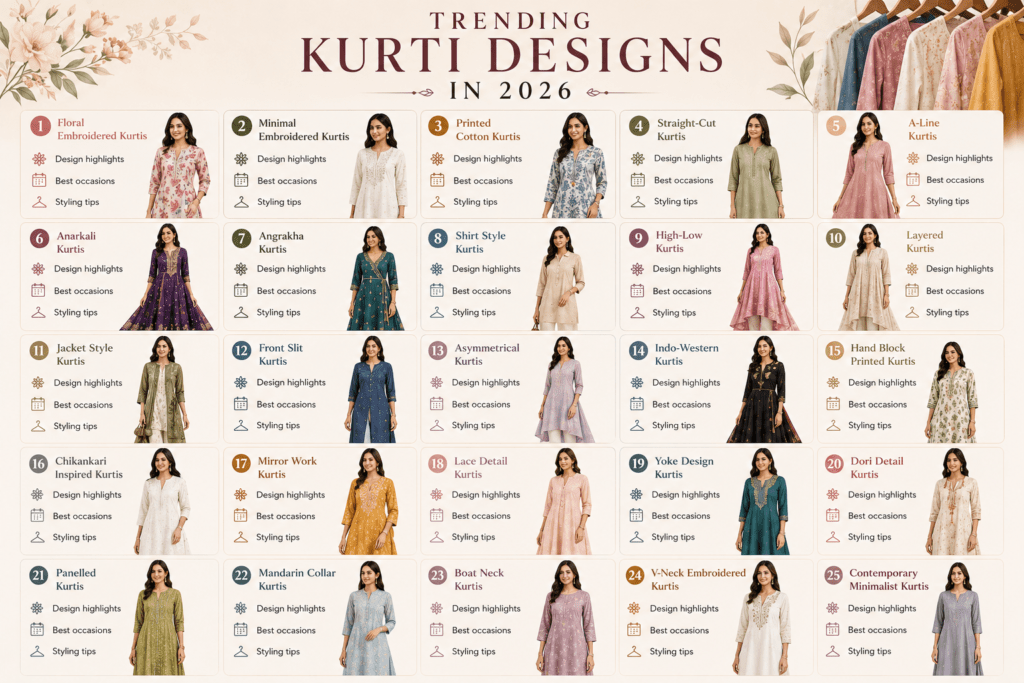
I am going to walk you through the styles I keep circling back to, both as a designer and as someone who genuinely wears these every week. For each one, I will give you the design highlights, the best occasions to wear it, and a quick styling tip you can actually use.
Floral Embroidered Kurtis
Design highlights: Delicate floral motifs, usually placed along the neckline, sleeves, or hem, done in thread work rather than sequins. Best occasions: Family gatherings, festive lunches, everyday elegance. Styling tips: Keep the bottom simple, a plain palazzo or straight pants, so the embroidery stays the focus.
Minimal Embroidered Kurtis
Design highlights: A single line of embroidery, often along the placket or collar, on an otherwise plain fabric. Best occasions: Office wear, brunches, everyday styling. Styling tips: Pair with jhumkas and a clean bun for an effortlessly put-together look.
Printed Cotton Kurtis
Design highlights: Block prints, small motifs, or abstract patterns on breathable cotton. Best occasions: College, casual outings, summer days. Styling tips: These work beautifully with jeans if you want a fusion look, more on that a little further down.
Straight-Cut Kurtis
Design highlights: A clean, structured silhouette that falls straight from shoulder to hem. Best occasions: Office, formal meetings, daily wear. Styling tips: Choose slightly stiffer fabrics like cotton silk so the straight line holds its shape through the day.
A-Line Kurtis
Design highlights: Fitted at the bust, flaring gently towards the hem. Best occasions: Casual outings, college, weekend brunches. Styling tips: Flattering on almost every body type, especially if you want a bit of movement without too much volume.
Anarkali Kurtis
Design highlights: Fitted bodice with a flared, floor-sweeping or knee-length skirt. Best occasions: Weddings, festive functions, evening events. Styling tips: Let the silhouette do the work. Keep jewellery statement but not overpowering.
Angrakha Kurtis
Design highlights: An asymmetrical, wrap-style front closure inspired by traditional royal attire. Best occasions: Festive wear, family functions. Styling tips: Pair with a contrasting dupatta to highlight the wrap detail.
Shirt Style Kurtis
Design highlights: Collar, button placket, and sometimes cuffed sleeves, borrowed straight from formal shirting. Best occasions: Office, professional settings. Styling tips: Tuck it into straight pants for a polished, workwear-ready look.
High-Low Kurtis
Design highlights: Shorter at the front, longer at the back, adding movement and drama. Best occasions: Parties, evening gatherings. Styling tips: Works best with leggings or slim pants so the hemline stays the focus.
Layered Kurtis
Design highlights: Two or more fabric layers, often a sheer or net overlay on a solid base. Best occasions: Weddings, festive celebrations. Styling tips: Balance the volume with minimal accessories.
Jacket Style Kurtis
Design highlights: A structured, open-front jacket layered over a fitted inner kurti. Best occasions: Weddings, receptions, festive evenings. Styling tips: Choose a contrasting inner and outer fabric for visual depth.
Front Slit Kurtis
Design highlights: A vertical slit at the front hem, adding ease of movement. Best occasions: Casual and semi-formal outings. Styling tips: Pair with palazzos or straight pants for balanced proportions.
Asymmetrical Kurtis
Design highlights: Uneven hemlines, angled cuts, or off-centre closures. Best occasions: Parties, contemporary festive settings. Styling tips: Let the hemline be the statement, keep everything else understated.
Indo-Western Kurtis
Design highlights: Traditional kurti shapes fused with western elements like collars, cinched waists, or shirt hems. Best occasions: Fusion parties, dinners, casual celebrations. Styling tips: Style with denims or culottes for an easy, modern look.
Hand Block Printed Kurtis
Design highlights: Traditional hand-stamped patterns, often in indigo, rust, or earthy tones. Best occasions: Casual wear, day events, gifting. Styling tips: These carry so much character on their own, skip heavy jewellery entirely.
Chikankari Inspired Kurtis
Design highlights: Delicate white or pastel thread work, traditionally from Lucknow, now reinterpreted in modern silhouettes. Best occasions: Summer festive wear, daytime functions. Styling tips: Best on lightweight cotton or georgette to let the embroidery breathe.
Mirror Work Kurtis
Design highlights: Small mirror embellishments, often paired with thread embroidery. Best occasions: Festive functions, Navratri, celebratory evenings. Styling tips: Keep the rest of the outfit simple so the mirror work catches the light without competition.
Lace Detail Kurtis
Design highlights: Delicate lace trims along the neckline, sleeves, or hem. Best occasions: Semi-formal events, evening gatherings. Styling tips: Works beautifully on solid, muted base colours.
Yoke Design Kurtis
Design highlights: A decorative panel at the chest, often embroidered or contrast fabric. Best occasions: Everyday wear with a festive edge. Styling tips: A great option if you want detail without covering the whole kurti in embellishment.
Dori Detail Kurtis
Design highlights: Fabric cording used at the neckline, waist, or sleeves for texture. Best occasions: Casual and semi-casual outings. Styling tips: A subtle way to add interest to an otherwise plain kurti.
Panelled Kurtis
Design highlights: Multiple fabric panels stitched together for a flared, structured silhouette. Best occasions: Festive and semi-formal wear. Styling tips: Choose panels in complementary tones for a cohesive look.
Mandarin Collar Kurtis
Design highlights: A short, standing collar borrowed from Indo-western tailoring. Best occasions: Office, formal settings. Styling tips: Pairs beautifully with straight pants for a crisp, structured look.
Boat Neck Kurtis
Design highlights: A wide, horizontal neckline that sits along the collarbone. Best occasions: Casual and semi-formal wear. Styling tips: Flattering for most face and neck shapes, and easy to dress up with statement earrings.
V-Neck Embroidered Kurtis
Design highlights: A V-shaped neckline with embroidery framing the edge. Best occasions: Festive and evening wear. Styling tips: Elongates the upper body, great if you want a slightly more elevated everyday look.
Contemporary Minimalist Kurtis
Design highlights: Clean lines, no embellishment, relying entirely on fabric and cut. Best occasions: Office, daily wear, travel. Styling tips: Invest in good fabric here since there is nowhere for it to hide.
For a deeper breakdown of these silhouettes and how they differ structurally, I have written a full piece here: Types of Kurti Explained (2026): 18 Popular Styles & How to Choose the Right One.
Trending Colours for Kurti Designs in 2026
Colour changes the entire personality of a kurti, sometimes more than the cut itself. Here is what is trending and where each shade works best.
Sage Green feels calm and earthy, wonderful for daytime festive wear or casual outings.
Dusty Rose is soft and flattering across most skin tones, lovely for family functions.
Ivory works as a base for embroidery-heavy kurtis and feels effortlessly elegant.
Emerald Green brings richness, perfect for weddings and evening events.
Mustard is a festive classic, especially through the winter months.
Deep Maroon carries warmth and works beautifully for ceremonies and pujas.
Lavender is soft and versatile, good for both casual and semi-formal settings.
Navy Blue is a safe, sharp choice for office wear and formal outings.
Chocolate Brown feels grounded and pairs well with gold jewellery for festive looks.
Classic White remains timeless, especially for summer and Chikankari styles.
Best Fabrics for Trending Kurti Designs
The fabric decides how a design actually behaves once you are wearing it, not just how it photographs. Here is a quick rundown.
Cotton breathes well and suits daily wear, especially printed and hand block designs. Rayon drapes beautifully and holds embroidery detail well without feeling heavy. Linen is ideal for warm weather and pairs beautifully with minimalist cuts. Silk adds richness and works best for festive and wedding kurtis. Cotton Silk balances comfort and elegance, a favourite for semi-formal wear. Georgette is light and flowy, perfect for layered and high-low kurti designs.
If fabric choice is something you find genuinely confusing, and honestly most people do, I have broken it all down here: Kurti Fabric Guide (2026): 15 Popular Fabrics & How to Choose the Right One.
Which Kurti Design Suits Different Occasions?
I get asked this constantly, so here is a simple reference table.
| Occasion | Recommended Design |
|---|---|
| Office | Straight, Shirt Style |
| College | Short Printed Kurti |
| Casual Outing | A-Line, Cotton Printed |
| Festive | Embroidered, Anarkali |
| Wedding | Jacket Style, Layered |
| Family Gathering | Floral Embroidered |
How to Choose the Right Kurti Design
This is the part I wish more people paused on before shopping. Trends are fun, but the right kurti design for you depends on a few personal factors.
Body Shape: A-line and straight cuts flatter most body types, while empire waists suit those who want a more defined silhouette.
Height: Shorter kurtis work well on petite frames, while taller women can carry high-low or layered styles beautifully.
Occasion: Match the embellishment level to the setting. Save heavy embroidery for festive days, keep daily wear minimal.
Fabric: Choose breathable fabrics for daily wear and richer fabrics for evening or festive occasions.
Neck Design: Necklines change how a kurti frames your face, boat necks and V-necks are especially versatile.
Comfort: No design is worth wearing if you are adjusting it all day. Comfort should never be an afterthought.
Personal Style: At the end of the day, the best kurti designs are the ones that actually feel like you.
If you are torn between lengths, I have a whole comparison here: Long Kurti vs Short Kurti. And if necklines are where you keep getting stuck, this one will help: Kurti Neck Design Guide.
Common Mistakes When Buying Trendy Kurtis
I have made a few of these myself early on, so trust me when I say they are worth avoiding.
- Following trends without considering your own body shape
- Ignoring fabric quality just because a design looks good online
- Choosing uncomfortable fits because they photograph well
- Buying overly embellished kurtis for everyday wear, they rarely get worn
- Not thinking about wardrobe versatility, a kurti should work with more than one bottom
Expert Styling Tips
A few things I always tell people who ask me how to build a kurti wardrobe that actually gets worn, not just admired.
Build your wardrobe around versatile, neutral designs first. Add one or two statement embroidered kurtis specifically for festive occasions. Balance heavily detailed kurtis with simple, minimal accessories so the outfit does not feel busy. And invest in a few timeless silhouettes alongside your trend-driven pieces, because trends shift but a well-made straight kurti will outlast most of them.
If you love saving inspiration boards, you will notice most kurti designs pinterest collections lean heavily into exactly this mix, a few statement pieces surrounded by versatile everyday staples. It is not an accident. It is just what actually works.
Conclusion
Fashion trends will keep shifting every year, that part never changes. But what I have learned designing kurtis season after season, for Duova Studio, is that timeless silhouettes, quality fabrics, and thoughtful styling are what actually make a kurti last in someone’s wardrobe, not just their Pinterest board. So as you explore this year’s kurti designs, latest cuts and all, I would just say this. Choose what reflects current trends, sure, but choose what reflects you a little more.
FAQs
Which kurti designs are trending in 2026?
Minimal embroidery, floral thread work, statement sleeves, and Indo-western silhouettes are leading this year, alongside hand block prints and Chikankari inspired styles.
Which kurti design is best for daily wear?
Straight-cut and A-line kurtis in breathable cotton or cotton silk are the easiest to wear day to day, especially for kurti designs for women balancing work and casual outings.
Are floral embroidered kurtis still in fashion?
Yes, though the styling has shifted. Instead of dense, multicoloured florals, 2026 favours delicate, single-tone thread work placed along the neckline or hem.
Which design suits petite women?
Shorter, straight-cut kurtis with vertical detailing, like front slits or panelled seams, tend to elongate the frame nicely.
What colours are trending in 2026?
Sage green, dusty rose, ivory, and mustard are dominating this year, alongside deeper festive shades like emerald green and maroon.
Which fabric is best for modern kurtis?
Cotton and linen remain the most practical for daily wear, while silk and georgette suit festive and evening kurti designs.
Which kurti design works best for the office?
Shirt style and straight-cut kurtis with mandarin collars read as the most polished for professional settings.
How can I style a trendy kurti?
Keep the styling proportional to the design. A heavily embroidered kurti needs minimal accessories, while a plain, minimalist kurti can carry bolder jewellery. And if you want a more casual, fusion look, kurti designs with jeans continue to be one of the easiest ways to modernise a traditional silhouette.